
The name Ishidaya originates from the spirit of Yoshinosuke Ishida, a samurai born in the Meiji era who lived in Yaizu, Shizuoka. In this land where mountains meet the sea, he dedicated his life to bringing nature’s blessings—both from land and ocean—to the people, embodying a philosophy that food connects humanity with nature.
The name “Sandaime” (“third generation”) carries with it not only the weight of legacy, but also a vow to elevate tradition into the future. With a mastery that draws out the essence of each ingredient, a harmony between cuisine and its vessel, and hospitality rooted in ichigo ichie—the once-in-a-lifetime encounter— We express the soul of Japanese cuisine here in Hanoi, guided by the belief that “culinary artistry is the craft of transforming delight into happiness.”
Space – The Harmony of East and West
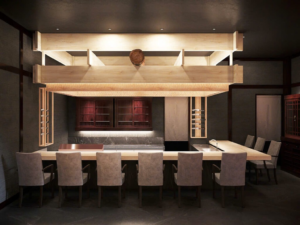
At Ishidaya, our space blends traditional Japanese craftsmanship with European Art Nouveau:
Western Elements: Stained glass, soft curves, and warm lighting that evoke the Taisho period.
Japanese Elements: Natural wood furniture, lacquered pieces, and finely crafted artisan accents.
Cuisine – Seasonal Elegance, Rich with Taisho Spirit
Every dish at Ishidaya reflects a delicate balance between traditional Japanese flavors and modern innovation:
We select seasonal ingredients that honor the natural freshness and essence of each ingredient.
The pairing of sake, champagne, and wine elevates the flavors of our carefully crafted dishes.
Philosophy in the kitchen is…
Cooking is a means of bringing happiness through the mouth, of making people smile through food.”
Born in 1976 in Yaizu City, Shizuoka Prefecture
Trained as a chef at Alaska French Restaurant (Shizuoka), Japanese restaurant Hoshikawa (Tokyo), Hatsushima Club (Shizuoka), Grand XIV Hamanako (Shizuoka), and XIV Yamanakako (Yamanashi).
Later, as head chef, he gained experience in Japanese restaurants in Malaysia and Singapore, and has been living in Vietnam since 2018
Opening 4 restaurants in Vietnam since 2018
He is trained in Ohara-ryu flower arrangement and Omotesenke tea ceremony
He is also certified chef of Tokyo Puffer fish cooking chef and sake sommelier
Opening ISHIDAYA the 3rd Generation as a culmination of 30 years of chef’s life in this milestone year
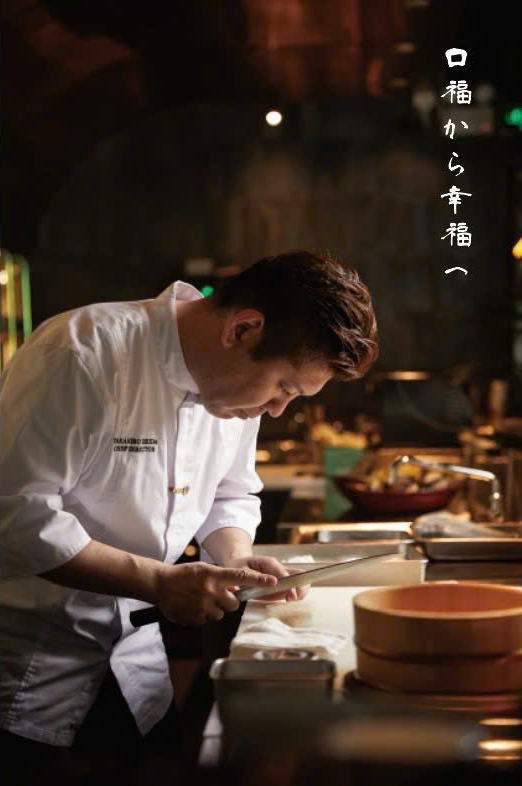
Takahiro Ishida
Founder / Head Chef
We draw our dashi from kombu from Rishiri Island in Hokkaido, together with bonito flakes and tuna flakes from Yaizu in Shizuoka, the hometown of our owner-chef, selecting the most suitable balance for each dish.
For clear soup, we use meiji-bushi, a fragrant and elegant tuna flake.
For simmered dishes and chawanmushi, we use bonito flakes for a fuller depth of umami, preparing each stock according to the character of the dish.
We are equally exacting about water.
Rather than tap water, Ishidaya uses natural soft water from Vietnam, which allows the umami of kombu to unfold gently and fully.
The kombu is held at 60°C for one hour to draw out its flavor with care.
Only then are the flakes added, after which the stock is extracted and strained quietly and delicately.
It is an unobtrusive process, yet this accumulation of detail gives depth to our soups, simmered dishes, and chawanmushi.
Chawanmushi, too, reflects Ishidaya’s philosophy of dashi.
Within its gentle texture, the savor of the stock is layered quietly, allowing each ingredient to reveal its own character.
Though it differs in expression from a clear soup, both are born from the same view of dashi that defines Ishidaya.
At Ishidaya, both clear soup and chawanmushi are not simply warm dishes.
They are important expressions through which we convey the dignity and refinement of dashi.
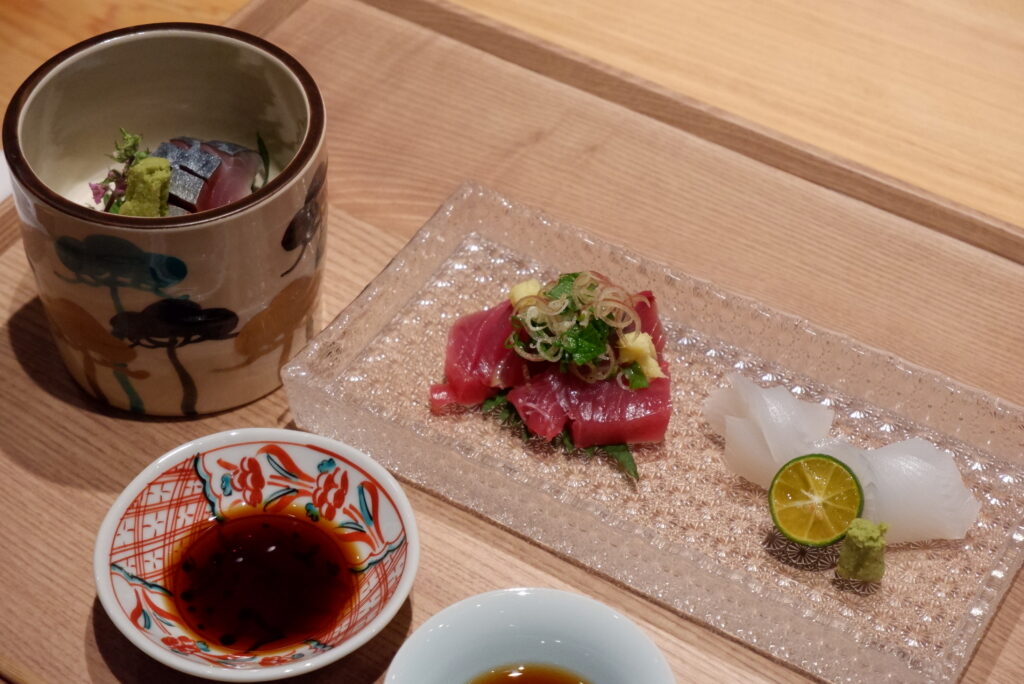
To draw out the full potential of each fish’s umami, we work carefully according to its character—aging, vinegar-curing, searing the skin, blanching, or kombu-curing—choosing the method that best reveals its nature.
Even the same fish calls for a different approach depending on its condition, fat, and aroma.
At Ishidaya, we seek the moment at which each fish tastes most beautiful, and only then do we compose it into a plate.
We are equally uncompromising with the condiments that accompany sashimi.
Our soy sauce is authentic soy sauce brewed in traditional wooden vats.
To this we add a small amount of junmai sake, then infuse it lavishly with bonito flakes and kombu over two weeks, allowing their umami to deepen the sauce.
That is why Ishidaya’s sashimi soy sauce carries a gentle sweetness and profound richness.
To work not only on the fish itself, but also on the soy sauce that accompanies it—
this too is an essential part of sashimi at Ishidaya.
Regarded as the finest of charcoals, binchotan offers both powerful heat and remarkable stability, making it the ideal fuel for the delicate grilling techniques of Japanese cuisine.
Its strong heat sears the surface with fragrance while keeping the umami within.
As a result, the exterior carries a fine aroma, while the inside remains tender, plump, and supple.
The depth of fragrance created by charcoal fire also enhances the natural character of fish and meat, lending both depth and lingering finish.
Its ability to drive off excess moisture while sharpening the outline of the ingredient is another virtue unique to charcoal.
At Ishidaya, grilling is not seen as mere cooking by heat.
It is an essential process through which the beauty of an ingredient is brought to completion.
By facing the fire of binchotan directly, we pursue the most beautiful doneness for each and every dish.
For that reason, we design not only the ingredients themselves, but also the oil, flour, and water with great precision.
Our frying oil is an original blend of rice oil, roasted oil, and refined white sesame oil.
The ratio is reviewed season by season and adjusted according to temperature, humidity, and the character of the ingredient.
It is a way of bringing forth aroma without weight, creating a light batter and a graceful finish.
For the flour, we use domestically produced low-gluten wheat flour, stored under frozen control.
By preventing unnecessary change and maintaining a stable condition, we support a delicate and consistent fry.
The water used for tempura is also deliberately different from the soft water used for dashi.
For tempura, we intentionally use hard water, as it helps the batter stand more cleanly and produces a lighter, crisper texture.
Chef Ishida thinks of tempura as “the ultimate steamed dish.”
By enveloping the ingredient instantly in high-temperature oil, moisture and umami are retained within, while the outside remains light and crisp, and the inside tender and plump.
In that sense, tempura is not merely fried food, but a refined form of heat control that guides an ingredient to its most delicious state.
At Ishidaya, we also take great care with the salts served alongside tempura.
We prepare our own blends of matcha salt, curry salt, and fine powdered salt to highlight the character of each ingredient.
Our tentsuyu is made in a richer style, with the umami of bonito brought clearly forward.
Served with a generous amount of grated daikon, the aftertaste becomes cleaner and gentler, while also aiding digestion.
It may be enjoyed with the tempura itself, or even on its own between bites.
Tempura may appear to be a simple dish, yet in truth it is sustained by a delicate balance of aroma, thinness of batter, and the way heat enters the ingredient.
At Ishidaya, we pursue tempura that preserves the true character of the ingredient while leaving behind a deep sense of satisfaction within its lightness.
Among Kumamoto wagyu, Waoh is a designation given only to cattle that satisfy rigorous standards, including meat quality grades of 4 or 5, a BMS score of 6 or higher, and an age of at least 28 months.
Its great appeal lies in its fine marbling, melting texture, fragrant depth of flavor, and gentle richness of fat.
At Ishidaya, we do not present Waoh merely as luxury.
Instead, we draw out its character carefully through the heat control and composition of Japanese cuisine, so that both the sweetness of the fat and the umami of the lean meat may be felt beautifully together.
This is an expression made possible precisely because Waoh itself possesses exceptional quality.
As a signature expression of wagyu, Ishidaya also treasures its Chaliapin steak.
Chaliapin steak was created in 1934 for Feodor Ivanovich Chaliapin, the Russian opera singer who stayed at the Imperial Hotel.
Because he was unable to eat steak easily due to dental trouble, onions were used to tenderize the meat, taking sukiyaki as a point of inspiration.
Ishidaya’s Chaliapin is built on respect for that classic, yet reconstructed through the dignity of Waoh and the fire control of Ishidaya.
It does not end with tenderness alone.
The umami of the wagyu, the sweetness of the onion, and the lingering resonance of the dish are brought together as one.
At Ishidaya, wagyu is expressed not merely as a feast, but as a plate that unites technique with story.
Ishidaya also values sukiyaki as another expression of wagyu.
Gyunabe, regarded as the forerunner of sukiyaki, was one of the dishes that became widely enjoyed during Japan’s era of civilization and enlightenment from the Meiji into the Taisho period.
With respect for that history, Ishidaya prepares a small hotpot of A5-grade Waoh using shoulder meat chosen for its fine balance of lean flavor and fat.
It is not flamboyance we seek, but the choice of a cut that allows the true savor of the beef to be deeply appreciated.
As the meat cooks in the pot, the aroma of wagyu, the sweetness of its fat, and the lingering finish of the warishita become one.
For Ishidaya, sukiyaki is one of the most familiar, yet also one of the deepest, ways of conveying the beauty of wagyu.
Its representative expression is our tender-braised beef tongue.
Beef tongue is not a dish that can be reduced to softness alone.
To preserve its umami, release its fibers, and guide it toward a texture that quietly yields in the mouth requires delicate work in every aspect: heat control, seasoning, and the layering of flavors.
At Ishidaya, this tender-braised tongue is served with potato purée.
The umami of the softened tongue, the deep richness of the sauce, and the gentle sweetness and aroma of the potato overlap to create a more dimensional flavor.
Within a single bite, umami, richness, and fragrance unfold in layers and swell quietly outward.
That is the essential charm of this dish.
At Ishidaya, we treasure this plate not merely as a signature item, but as a dish through which the techniques and sensibility inherited from a master continue to be refined within the flow of the restaurant today.
To inherit is not to imitate a form, but to understand its essence and deepen it as one’s own cuisine.
This “Dish Inherited from the Master” exists not only to speak of apprenticeship.
It is a plate that quietly tells where the technical foundation of Ishidaya lies, and how those lessons continue to live in the present.
Its representative expression is cured mackerel.
When the owner’s grandfather was alive, mackerel was one of the specialties landed abundantly in Yaizu.
Just as it is used in local kuro hanpen, mackerel has long supported the food culture of Yaizu and remains one of the sea’s gifts most deeply rooted in that place.
At Ishidaya, with respect for the bounty of Yaizu’s sea, the memory of plum vinegar inherited from the grandfather’s era is refined into a dish for today.
By layering strained umeboshi over a tosazu jelly enriched with bonito, we express gentle acidity, umami, and the faint fragrance of plum within a single plate.
It is about tightening the fat of the mackerel while allowing its umami to stand out beautifully.
It is about adding the flavor of bonito, so characteristic of Yaizu, together with inherited wisdom.
At Ishidaya, we regard this dish not merely as a memory of regional cuisine, but as an expression of reverence for the sea of Yaizu, of technical inheritance, and of its elevation into the present Ishidaya.
The “Heritage Plate” is not a dish meant only to speak of nostalgia.
It is a plate that quietly tells where Ishidaya has grown from, what it has inherited, and what it intends to pass on next.
Its dense umami, thick richness of fat, fragrant aroma, and deep lingering finish give it the strength to carry a plate by itself.
At Ishidaya, we use large eels weighing over one kilogram.
They are purchased alive, dispatched and bled, and then not used immediately.
Instead, they are quietly aged for at least five days to one week, allowing the fat to settle and the umami to deepen, refining the flavor into something more beautiful and composed.
It is an essential period through which strength acquires dignity.
Our method is Kanto-style.
The eel is first grilled plain, then steamed, and only then finished as kabayaki.
Steaming once helps release excess heaviness, guiding the flesh toward a plump and tender texture before the final fragrant grilling.
As a result, aroma rises on the surface while the deep, characteristic savor of eel fills the inside quietly.
The tare is also one of the key elements that shape Ishidaya’s eel.
Its foundation comes from techniques inherited from a master.
From there, it has been further refined by Ishidaya so that it sits naturally within Vietnam’s climate, food culture, and local sensibilities.
Inheritance and elevation—both are layered together in the flavor of Ishidaya’s eel.
The beauty of eel lies not only in its intensity.
Within that umami resides an overwhelming vitality.
At Ishidaya, we do not present that force in a rough form; rather, we refine it through aging and fire so that it may be experienced deeply and with elegance in a single plate.
To taste the vitality of eel—
this too is part of the expression that Ishidaya treasures.
At Ishidaya, eel appears in many forms: grilled dishes, kabayaki, shirayaki, eel rice bowls, hitsumabushi, and chawanmushi.
One of its greatest attractions is that, although it is a single ingredient, its expression can change dramatically depending on how it is prepared.
Through these varied forms, Ishidaya seeks to convey the profound depth of eel as an ingredient.
At Ishidaya, eel is treasured not merely as a specialty, but as a plate that reflects both the power of the ingredient and the depth of technique.
We value the quiet aftertaste appropriate to the close of Japanese cuisine, while also allowing the owner-chef Takahiro Ishida’s years of training, together with the memory of home, to live within a single plate.
For example, there is our matcha affogato, made by pouring Shizuoka matcha over house-made vanilla ice cream.
There is also “Bernachon,” a caramel ice cream rooted in techniques learned during Ishida’s years training in French cuisine.
And our pudding is one of Ishidaya’s most cherished sweets, based on the mother’s recipe and reflecting distant childhood memories.
It leaves behind a quiet, nostalgic impression.
At the same time, wagashi remains an indispensable expression at the close of the meal.
One such example is Ishidaya’s collagen water mochi, made from natural water set with agar and fish collagen.
It was inspired by the water shingen mochi that Ishida encountered while working in Yamanashi.
Building on the impression of that sweet—its transparency and transience—Ishidaya adds fish collagen to create a uniquely soft texture that dissolves quietly in the mouth and leaves a delicate lingering finish.
We also prepare other sweets according to the season and the course, including warabi mochi and monaka.
Rather than leaning entirely toward either wagashi or Western sweets, Ishidaya receives the beauty of both and shapes them into desserts suited to the restaurant today.
At Ishidaya, sweets are not simply desserts served after a meal.
They are a final plate that receives the lingering impression of the cuisine and leaves one last gentle memory.
They are the closing expression in which the owner-chef’s path, the memory of family, and both Japanese and Western techniques are reflected in quiet balance.
It is a cup we have adopted, drawing on wisdom learned in kaiseki cuisine, in order to settle the lingering impression of the meal with quiet grace.
The tea itself comes from Shizuoka, a region that also connects to the owner-chef’s birthplace.
By roasting a tea of fine fragrance and gentle depth, we bring forth a warm, calm aroma that is especially suited to the close of a meal.
By adding only the slightest touch of salt, the fragrance of the hojicha becomes more dimensional, gently loosening the lingering flavors of the cuisine while bringing the palate to a clean and composed finish.
The warmth of the roasted tea settles the aftertaste, while the small measure of salt sharpens the outline of flavor.
In this way, it creates a light and quiet finish appropriate to the end of a meal.
At Ishidaya, tea is not regarded merely as a final drink.
It is an important cup that refines the last impression of the cuisine and carries the beauty of the experience into the moments after the meal.
Our salted hojicha is a modest yet essential ending—one that quietly ties together the meal at Ishidaya.
No matter how refined the food may be, if the vessel that receives it and the space in which it is placed are not in harmony, the expression of Ishidaya is not yet complete.
At the foundation of Ishidaya’s atmosphere lies an aesthetic often associated with the Taisho Romantic era.
This does not mean reproducing old Japan exactly as it was.
Rather, it means treasuring Japanese tradition while naturally receiving new sensibilities and different cultures.
It has weight without feeling old-fashioned, and elegance without becoming noisy.
Ishidaya values precisely this sense of calm, dignity, and quiet refinement.
That sensibility extends not only to the cuisine, but also to the making of the space itself.
The counter on the second floor was designed with inspiration drawn from Japanese shrines and temples.
In the layered timber structure above and the way the beams are revealed, there is a quiet tension reminiscent of sacred architecture.
At its center stands a sacred tree weighing approximately 300 kilograms.
In Japan, there is a long-held belief that great old trees may become dwelling places of the divine.
At Ishidaya, that distinctly Japanese reverence is also woven into the atmosphere of this space.
Ishidaya also values not merely creating a space out of new materials, but allowing time-worn things to live again.
Some of the metal fittings used on the shelves and architectural details are original Taisho-era pieces brought from Japan, then restored and polished here before being used again.
Rather than displaying old things as decoration alone, we believe in refining them so they can breathe again within a living space.
That way of thinking is also part of Ishidaya.
The vessels, too, are never simply tools for plating.
They receive the color, temperature, texture, negative space, and even the atmosphere carried by each dish.
At Ishidaya, we use a wide range of pieces with distinct expressions, including sometsuke blue-and-white porcelain, aka-e overglaze redware, silver-glazed pieces, lacquerware, and glass.
We also incorporate Bohemian glass, Edo Kiriko cut glass, and Nosaku cast-metal sake vessels, arranging them so that both cuisine and drink may appear at their most beautiful.
From mukozuke dishes, long plates, small plates, covered vessels, bowls, deep bowls, kaiseki trays, tea saucers, and sake vessels, each piece is chosen in response to the dish it serves.
Rather than relying on one vessel for everything, we value preparing the most appropriate form of reception for each course.
For sashimi, vessels that allow quietness and negative space to live.
For grilled dishes and tempura, forms that express contour and dimension with clarity.
For soup, bowls that make even the act of lifting the lid and receiving the first aroma feel beautiful.
For the time of sake, vessels chosen with awareness of weight in the hand and feel upon the lips.
At Ishidaya, we arrange not only the food itself, but also how it is to be seen and felt.
The setting, too, is an important part of our work.
It should not be overly assertive, yet it must never feel empty.
The presence of wood, the texture of old metal fittings, the way red is placed, the light held within shadow, and the combinations of vessels—
by layering such elements, Ishidaya creates an atmosphere that is proper without being rigid, and elegant without losing composure.
And while Ishidaya values Japanese technique and aesthetics, it never forgets its respect for the land of Vietnam.
Rather than copying Japan as it is, we seek forms that can exist naturally within the air of Vietnam.
That way of thinking is equally important in our vessels and our setting.
A dish is only truly complete when it is placed in its vessel and set within its space.
At Ishidaya, we consider even that final moment to be part of the cuisine itself.
 EN
EN  JA
JA  VI
VI